Type of Habitats
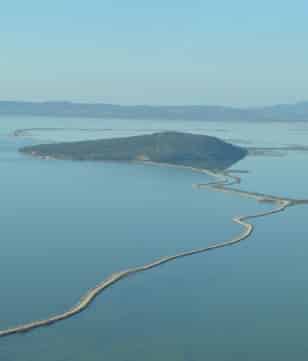
Amvrakikos is one of the most complex wetlands mosaic in Greece. The Amvrakikos Wetlands National Park includes sixteen natural habitats types according to the evaluation criteria of Directive 92/43/EEC. Most lagoons are sited in the northern part of the Amvrakikos gulf, formed by the action of the alluvial rivers Arachthos and Louros. The biggest part includes the complex “Rodia, Tsoukalio, Avleri” found on the west side of the hill of Salaora and the lagoon Logarou east of the same hill. Two of the three largest lagoons, Tsoukalio and Rodia are interconnected, creating a rare double lagoon cluster.
Other impressive natural formations of the area are the barrier-islets that have been created among the lagoons of the Amvrakikos gulf. The lagoon Saltini and Voulkaria Lake have a significant role as they are spread boundaries of the protected species Carexacuta (Carexpanormitana Guss).
The largest pure reed bed of the Balkans, Rodia, along with the salt water marshes of Arachthos and the fresh water marshes of Louros, are some of the major and most important habitat types. A great variety of vegetation can be found, across the hills of the extended region (Mavrovouni, Salaora, Prophet Elias, Saint Ekaterini) that consists of thermophilic deciduous species of oak such as downy oak (Quercus pubescens), broadleaved oak (Quercus frainetto), holm oak (Quercus coccifera), wild olive (Olea oleaster), ostrya (Ostrya caprinifolia), Asfaka (Flomis fruticosa) and Paliouri (Paliurus spina cristi).
Finally, one of the last remaining riparian forests of our country, called Saint Varnavas, is preserved near the village Louros. It is composed of clusters of Nerofraxon (Fraxinus angustifolia) and other hydrophilic broadleaf species.